Northeast Ohio residents report loud boom; National Weather Service says satellite data points to meteor
A sudden blast heard across the region
Residents across Northeast Ohio reported hearing and feeling a sharp, explosive boom on Tuesday morning, March 17, 2026, in an area spanning Cleveland and multiple surrounding suburbs. Some described a brief house-shaking jolt or a rolling rumble that followed the initial sound, prompting speculation ranging from an earthquake to an explosion or aircraft-related noise.
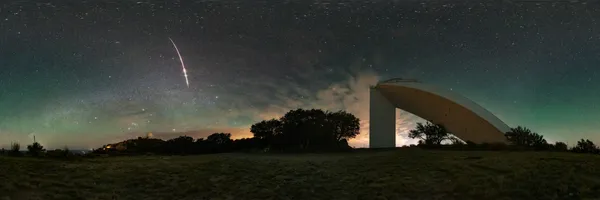
By midday, the National Weather Service office serving Cleveland said available satellite-based evidence indicated the sound was consistent with a meteor fireball breaking apart in the atmosphere, producing a sonic boom.
What the Weather Service says it saw
The agency pointed to data from the Geostationary Lightning Mapper, a sensor aboard NOAA’s GOES weather satellites designed to detect brief optical flashes in the atmosphere. While its primary mission is tracking lightning, the instrument can also register intense, fast light signatures associated with bright meteors. The Weather Service said its review of the satellite imagery around 1301Z (8:01 a.m. Eastern) supported the meteor explanation for the boom reported around the region.
In such events, a fast-moving object can generate a shock wave that reaches the ground as a loud boom, even when the object itself is not clearly seen from below.
How a meteor can produce a boom without a visible “impact”
Most meteor-related booms are not caused by something striking the ground. Instead, they occur when a meteoroid enters Earth’s atmosphere at very high speed and fragments, generating a pressure wave. Depending on altitude, speed, and atmospheric conditions, that wave may be heard over a wide area, with reports arriving from many neighborhoods at nearly the same time.
A bright meteor (often called a fireball) may be visible as a flash, streak, or brief flare.
The sonic boom can arrive seconds to minutes later, depending on the altitude of fragmentation and the distance from the observer.
A wide reporting footprint is common, because sound can travel and refract through different atmospheric layers.
What is not confirmed
As of Tuesday, there was no confirmed public report of meteorite fragments recovered on the ground associated with this event. A meteor sonic boom can occur even when nothing reaches the surface, or when small fragments land in areas where they are not immediately found.
Authorities typically advise residents to report any property damage through local channels. Anyone who believes they may have located an unusual rock associated with a fall is generally encouraged to document the location and condition before moving it, since provenance can be important for scientific verification.