Massive crack forms across Lake Erie ice as coverage nears 96%, raising safety concerns
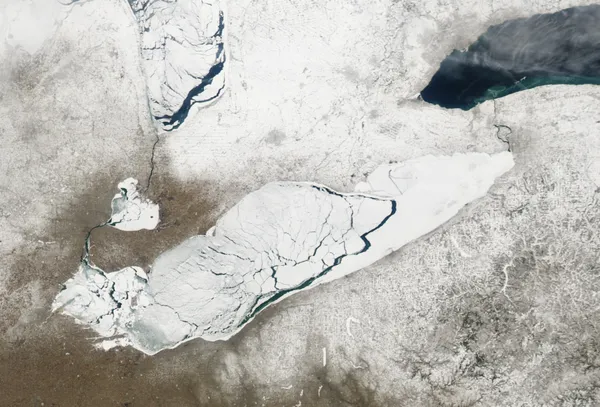
A newly visible fracture spans a major portion of the lake
A long, continuous crack opened across Lake Erie’s ice over the weekend of Feb. 8–9, 2026, as the lake’s ice cover surged to the mid-90% range amid prolonged cold. Satellite imagery captured the fracture developing and extending across the frozen surface, producing a prominent separation line in the ice sheet.
Lake Erie, the shallowest of the Great Lakes, typically responds fastest to Arctic outbreaks and can approach near-complete ice cover in colder winters. This week’s widespread freeze set the stage for large-scale movement within the ice field—conditions that can produce fractures that expand quickly as wind, currents and temperature shifts stress the surface.
Why wide cracks can appear even when the lake looks “solid”
When ice coverage becomes extensive, the lake surface can appear uniformly frozen while still behaving like a moving, segmented sheet. Wind can push the ice pack, while underlying currents and shoreline constraints resist that motion. The result can be a rapid split, sometimes opening into a lead of open water or a thin, newly formed skim of ice that is not safe to cross.
Cracks can also widen or shift when temperatures rise toward freezing, weakening bonds between ice plates and reducing the strength of previously stable areas. Even where the ice refreezes overnight, the repaired section may be significantly thinner than surrounding ice and can fail under weight.
Incidents and warnings underline the risk to people on the ice
Emergency responders in the western basin have recently dealt with ice-related rescues involving recreational vehicles. In one incident near Port Clinton, two people were thrown into the water after a four-wheeler broke through near a crack several feet across; both were recovered and evaluated after being brought back to shore.
Public safety agencies have repeatedly warned that no Great Lakes ice should be considered reliably safe for travel, particularly during periods of changing wind and temperature. Large cracks are especially dangerous because they can be difficult to detect at speed, can be obscured by snow, and can expand between the time a person goes out and the time they attempt to return.
What to watch for along the shoreline and near islands
Conditions can be most volatile near pressure ridges, channels, river mouths, and around island areas, where moving ice can stack, split or separate. A wide crack can also become a boundary between ice that remains attached to shore and ice that begins to drift, increasing the likelihood that people could be stranded.
- Assume cracks may be wider than they appear and may hide thin refrozen sections.
- Avoid traveling by foot or vehicle on lake ice, especially after wind shifts or daytime warming.
- Expect conditions to differ sharply within short distances, even on the same day.
A lake can look fully frozen while remaining structurally unstable, with fractures that can open and migrate as the ice pack moves.
With Lake Erie’s ice cover near seasonal highs and a major fracture now evident, officials continue to emphasize that the safest choice is to stay off the ice entirely.